 TechTried-and-true tip
Fruit and potato battery from zinc and copper that lights an LED
Build a simple battery from a potato, zinc and copper that can light up an LED.
- Time
- ⏱ 30 min
- Difficulty
- ◆ medium
What you need
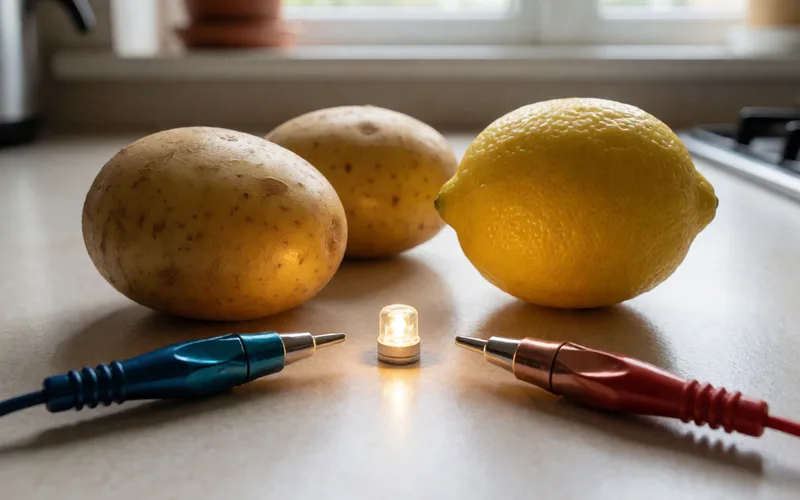
- 4 potatoes
- 4 zinc nails
- 4 copper coins (1, 2 or 5 cent)
- LED
- crocodile clip leads or electrical wire
- sandpaper
- knife
How to do it
- Rub the copper coins with sandpaper to remove the oxide layer.
- Push one zinc nail and one coin into each potato, making sure they don't touch.
- Connect the potatoes with wires and attach the LED.
- If the LED doesn't light, add two to three more potatoes.
Why it works
The acid in the fruit juice triggers a chemical reaction that pulls positively charged particles, called ions, out of the copper and zinc.
Variations
- Parallel connection: link the potatoes zinc to zinc and copper to copper.
- Lemon: you need 1 lemon, 1 zinc plate, 1 copper plate, sandpaper, LED, wires, crocodile clips and a knife. Cut two slits far apart in the lemon and sand both plates. Push the plates into the slits and connect them to the LED with wires and clips. The copper plate must go to the LED's longer lead.
- Apple: you need 2 sour apples, a copper sheet (about 24 cm), a zinc sheet (about 24 cm; galvanised iron sheet works too), 5 copper wires (about 15 cm) and 1 LED. Halve the apples, cut each sheet into 4 equal small plates and push them into the apple halves. Connect each zinc plate to the copper plate of another apple. Attach the remaining plates to the LED: copper to the positive lead, zinc to the negative. Lemons or other acidic fruit work too.
- Headphones instead of an LED: you need 1 potato, 1- or 2-cent coins, screws or nails and headphones. Push coins and nails or screws about 1 cm apart into the potato without letting them touch. The headphone plug has three metal parts separated by plastic. Hold the rear metal part against a coin and the tip against a screw or nail. Alternatively, hold a battery with two metal strips directly against the plug.
Sources
This is where we found the tip. The badge above shows how well it is backed up.
- science.lu (opens in a new tab)
4 Kupfermünzen (1 Cent, 2 Cent oder 5 Cent)“; „Reibe die Cent Münzen mit Glaspapier und entferne so die Oxydschicht.“; „Füge zwei bis drei Kartoffeln hinzu.
- daten.didaktikchemie.uni-bayreuth.de (opens in a new tab)
Schneide mit dem Messer zwei Schlitze in die Zitrone.“; „Das Kupferblech muss an den längeren Draht der LED angeschlossen werden.
- dlr.de (opens in a new tab)
Die Säure im Fruchtsaft des Apfels erzeugt“; „Jetzt sollte eure Leuchtdiode leuchten.
- bildungsmedien.vobs.at (opens in a new tab)
Halte das hintere Metallteil an eine Münze“; „eine Kartoffel“, „1- oder 2-Cent-Münzen“, „einen Kopfhörer